

From Commission to Final Score
From commission to final score: an honest look at composing—context, craft, smart renunciations, and fear—until the music finds its shape and begins to live in others.
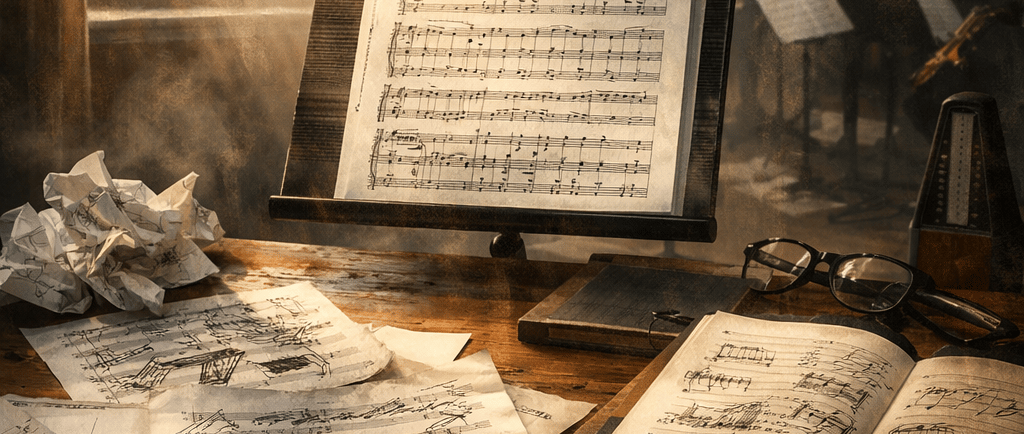
Sometimes composition is spoken of as if it were a territory reserved for inspiration: an idea appears, it is written down, and the music is fixed forever. Reality is less romantic and, at the same time, more human. A piece is born almost always from an awkward blend of desire and necessity: the desire to say something of one’s own and the necessity—ever more evident—of finding the context that makes it possible to say it.
Because even before the first note there is the question many composers know all too well: when will I be able to compose for real? I don’t mean “having an idea,” or writing loose fragments between obligations, but working with the continuity and time a piece requires. The problem is not only creative; it is structural. In the musical world there is a persistent paradox: people talk a lot about supporting creation, yet the composer often remains on the periphery of the system. Programmes repeat safe titles, budgets are tight, deadlines are short, and new music, too often, is treated as a risk to be minimised rather than a legacy to be built.
That is why, when a commission arrives—or simply the real possibility of a premiere—it is not only an artistic stimulus: it is also a rare opportunity. A window one has to seize, and which at the same time sets in motion a complex psychological mechanism. Because composing is not only writing music: it is exposing oneself.
The work begins long before the writing. It begins when one understands the context for which one is composing: what ensemble will play it, what kind of concert it will be, what expectations surround the premiere. And here a first dilemma already appears: the tension between what one wants to do and what one believes is “expected” of one. The temptation to adjust one’s language so as not to unsettle, to ensure a friendly reception, to avoid friction with performers or with the audience. That temptation may be understandable, but if the music is born only to fit in, it is born already weakened.
At some point a germ appears: a sonority, a gesture, an atmosphere, an inner phrase that cannot always be explained in words. It is the kind of material that, when it works, seems to have a personality of its own. Sometimes it is not “beautiful”; sometimes it is not “brilliant”; but it has truth. And that truth is what one pursues while writing, even if one is not always sure how to reach it.
From there the real work begins, and it is usually less linear than we imagine. Composition advances in leaps: days of clarity, days of fog. One writes a page convinced it is resolved and, the next day, it sounds alien, bloated, or unnecessary. Whole passages are removed. A section is re-orchestrated because the balance does not breathe. A transition is changed because it leads nowhere. A piece is, many times, a set of intelligent renunciations. And that is where one learns something fundamental: music does not end when “there is nothing left to add,” but when one has taken away what was not essential.
But even when craft is present and technique responds, there is an element that never disappears entirely: fear.
The composer lives with a particular kind of insecurity. It is not exactly the performer’s stage fright, nor the conductor’s uncertainty before a concert. It is another kind of vertigo: that of building something that does not yet exist, fixing it in a score, and accepting that, for a time, that music will depend on others in order to exist. And that is disarming.
There is fear that the piece will not be understood, that it will seem too dense, or too simple, or too long, or too short. Fear that an idea that felt inevitable in the studio will prove fragile in the hall. Fear that the piece will “not sound” as one heard it inwardly. And that fear is not only before the audience, which is unpredictable. Sometimes the most intense fear is felt before the musicians themselves.
Because the musician is the first real filter. The first reading of a piece shows no mercy: it reveals what works and what does not. It reveals whether a texture is well calculated, whether a breath was possible, whether a fingering made sense, whether a passage is difficult on purpose or difficult by accident. In that moment, one feels that it is not only the piece being judged, but also the competence and honesty of the person who wrote it. And there another tension appears: writing with ambition without falling into exhibitionism, demanding without being unfair, seeking a personal language without turning it into a labyrinth.
In band music this intensifies for an obvious reason: the band has enormous sonic power and physical impact, but also a delicate balance. You can write a beautiful idea and lose it in a mass of sound if you do not calculate projection. You can build a climax and have the low register fail to support the building. You can propose timbral transparency and have the space or the actual instrumentation turn it into noise. The composer therefore lives in a constant dialogue between imagination and real acoustics, between theory and rehearsal, between the ideal and the possible.
And yet, despite everything, something pushes one to continue. Perhaps because, deep down, composing is an attempt to respond to an inner need that cannot be resolved in any other way. There is something profoundly strange and beautiful about writing for people who have not yet played a single note, for an audience that still knows nothing of that music, for an immediate future in which that score will no longer be yours. That is another source of fear: the loss of control. When a piece is premiered, it no longer belongs only to the composer. The performance adds its own truth, its body, its risk. And if you are lucky, the piece becomes larger than the paper.
Here a reflection appears that feels urgent to me: if we want creation to have a real place in musical life, we need to make these opportunities something less exceptional. Everything cannot depend on isolated gestures or occasional commissions. New music needs continuity, not only events. It needs institutional trust and also a culture of performance: rehearsal time, dialogue with composers, the will to build a repertoire of the present. Because a piece is not established only by being premiered: it is established when it returns, when it is taken up again, when it finds different readings, when it ceases to be “new” and becomes music.
Perhaps that is why the process of composing, when looked at honestly, is not only a chain of technical decisions. It is also a portrait of our position as creators today: working between the precariousness of opportunities and the demand of public exposure, between craft and doubt, between what one wants to say and what the environment is willing to hear.
And yet, the piece is born. Sometimes with difficulty, sometimes with fury, sometimes with an unexpected calm. It is born when the composer accepts that fear is never fully overcome, but it can be crossed. It is born when one sits down to write even without guarantees, even without assured applause, even with the feeling of walking on shifting ground.
Because, in the end, composing is this: listening to music that does not yet exist and having the courage—and the patience—to give it shape so that others can make it sound.